Bored on Purpose: The Unexpected Superpower You Keep Trying to Escape
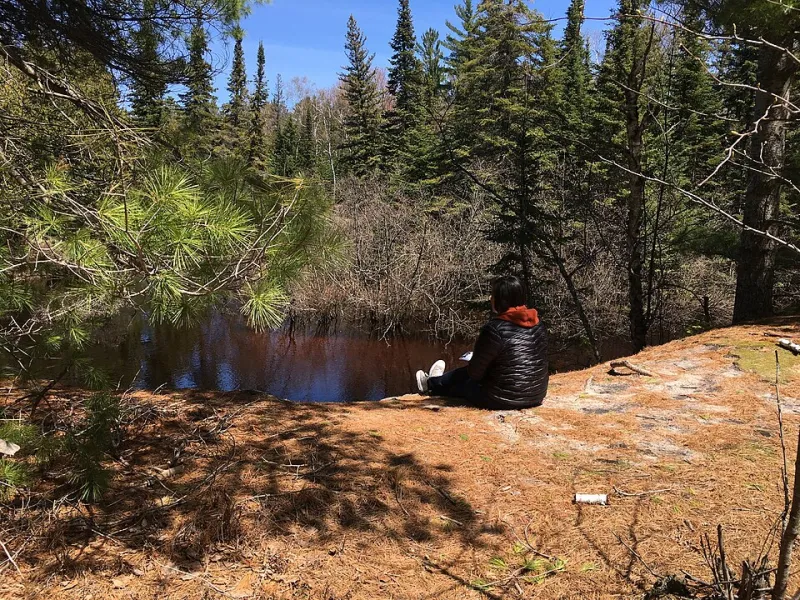
Photo: NPS, Public domain, via Wikimedia Commons
Your Brain Has a Secret Mode — and You Keep Interrupting It
Here's a scenario that probably sounds familiar: you're waiting for your coffee to brew, and within three seconds, your phone is already in your hand. You're not looking for anything specific. You're just... filling the gap. We've gotten so good at eliminating idle moments that we've accidentally declared war on one of our brain's most powerful states.
Boredom has a serious PR problem. In American culture especially, busyness has been elevated to a personality trait. Being slammed, overbooked, and perpetually stimulated signals importance, ambition, worth. But neuroscience is quietly building a case that this always-on lifestyle isn't making us sharper — it's actually making us duller.
Welcome to the world of strategic boredom. And yes, it's exactly what it sounds like.
What Happens When You Stop Feeding Your Brain Input
When your mind isn't actively processing something — a task, a podcast, a scroll — it doesn't just go quiet. It switches into what neuroscientists call the default mode network (DMN). Think of it as your brain's background operating system: the part that synthesizes memories, connects unrelated ideas, processes emotions, and essentially does the creative heavy lifting that focused work simply can't access.
Research out of the University of York found that mind-wandering — the mental state most associated with boredom — is strongly linked to creative insight and problem-solving. Meanwhile, a study published in Psychological Science showed that people who performed a boring task before a creative challenge significantly outperformed those who jumped straight in. Their brains had been given the space to start making unexpected connections.
In other words, boredom isn't the absence of thinking. It's a different kind of thinking — and we've been starving ourselves of it.
Why Constant Stimulation Is Costing You More Than You Think
We're living through an unprecedented experiment in human attention. The average American now spends over seven hours a day consuming digital media. Notifications, autoplay, algorithmic feeds — every system around us is engineered to make sure there's never a gap. And it's not neutral.
When we constantly outsource our mental downtime to external content, we're essentially never letting our default mode network do its job. The result? A creativity deficit. A growing inability to sit with discomfort. An exhaustion that sleep alone can't fix, because the brain never actually gets to process and integrate.
Artists, writers, and entrepreneurs have known this intuitively for a long time. Darwin took daily "thinking walks" with no destination and no agenda. Lin-Manuel Miranda has talked openly about the fact that the idea for Hamilton came to him on vacation — specifically when he was deliberately unplugged. These aren't coincidences. They're the default mode network doing exactly what it's built to do when we finally leave it alone.
High Performers Are Scheduling Nothing — Intentionally
A growing number of CEOs, creatives, and athletes are deliberately building unstructured time into their routines — not as a luxury, but as a performance strategy. Some call it "white space." Others call it "think time." Whatever the label, the concept is the same: time with no agenda, no input, no productivity goal.
Microsoft's former CEO Bill Gates famously takes twice-yearly "Think Weeks" — solo retreats with no meetings, minimal technology, and lots of time to just... think. Arianna Huffington rebuilt her entire philosophy around the idea that rest and mental space are competitive advantages, not indulgences.
This isn't about being lazy. It's about being strategic with the full spectrum of what your brain can do — and recognizing that the high-output mode isn't the only one that matters.
How to Actually Practice Strategic Boredom (Without Losing Your Mind)
Let's be honest: if you've been running on maximum stimulation for years, intentional boredom is going to feel deeply uncomfortable at first. That restless, itchy feeling when you don't immediately reach for your phone? That's the point. Sit in it.
Here are some practical ways to start reclaiming unstructured time without guilt:
Start smaller than you think you need to. You don't need a week-long digital detox. Begin with five to ten minutes of deliberate nothing — no music, no podcast, no phone. Sit with your coffee. Look out the window. Let your mind drift.
Protect transition time. The moments between tasks — walking to your car, waiting in line, sitting in a waiting room — are prime default mode network territory. Resist the reflex to fill them. Let them be gaps.
Take actual walks. Not walks with headphones. Not walks while texting. Just walks. Movement combined with mental wandering is one of the most well-documented creativity boosters we have.
Schedule it like a meeting. If open-ended time feels too abstract, block it in your calendar. "Thinking time: 11–11:30am." No agenda. That's the whole point.
Reframe the discomfort. That restless feeling when you're bored isn't a problem to solve — it's a signal that your brain is transitioning. The creative insight often comes after the discomfort, not instead of it.
The Guilt Is the Work
Maybe the hardest part of embracing strategic boredom in 2024 isn't the practice itself — it's giving yourself permission. We've internalized the idea that every moment should be optimized, monetized, or at least documented. Doing nothing can feel almost transgressive.
But here's the reframe: rest isn't the opposite of productivity. It's the foundation of it. When you deliberately create space for your brain to wander, you're not opting out of the game — you're playing a longer, smarter version of it.
So the next time you're tempted to fill a quiet moment with content, try leaving it empty instead. Your default mode network has been waiting for you. It's got some pretty good ideas to share.